
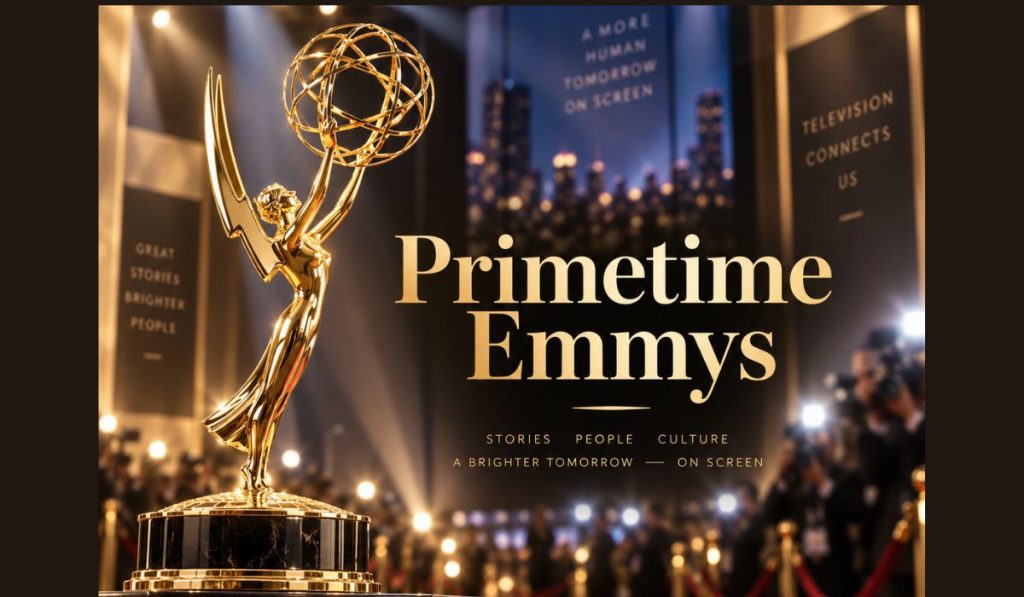
The Primetime Emmys are annual awards recognizing excellence in U.S. primetime television, including drama, comedy, limited or anthology series, reality programming, acting, directing, writing, and numerous creative crafts. Presented by the Television Academy, the awards are decided through peer voting by television-industry professionals. The competition dates to 1949 and has evolved alongside television itself, expanding from traditional broadcast networks to cable and major streaming platforms.
What Are the Primetime Emmys?
The Primetime Emmys are the Television Academy’s principal awards for outstanding achievement in programming that falls within its primetime competition.
They recognize both programs and individuals, meaning an Emmy can honor an entire series as well as an actor, writer, director, producer, designer, editor, composer, or other television professional. The Television Academy describes the Primetime Emmy as peer recognition from nearly 24,000 members, with members voting in areas connected to their professional expertise.
The awards encompass far more than the categories viewers normally see during the main television broadcast. Dozens of technical and creative honors are presented separately as part of the Emmy ceremonies, allowing specialized television crafts to receive recognition alongside high-profile series and performances.
Are the Primetime Emmys the Same as Every Emmy Award?
No, the Primetime Emmys are one part of the larger Emmy awards system.
The Television Academy administers the competition for primetime programming. The National Academy of Television Arts & Sciences, commonly called NATAS, independently oversees areas including Daytime, Sports, Children’s & Family, and News & Documentary awards. The International Academy of Television Arts & Sciences also presents awards for television produced outside the United States.
This distinction explains why someone can be described as an “Emmy winner” without necessarily having won a Primetime Emmy.
How Did the Primetime Emmy Awards Begin?
The Emmy Awards began in Los Angeles in 1949 before developing into a national institution recognizing television excellence.
The first ceremony was held on January 25, 1949, at the Hollywood Athletic Club and focused exclusively on local Los Angeles television. Ventriloquist Shirley Dinsdale, star of Judy Splinters, received the first Emmy for Outstanding Personality, while Pantomime Quiz Time won Most Popular Program.
As American television expanded during the 1950s, the Emmys broadened to recognize national programs and personalities. From 1954 through 1970, ceremonies originated from both Los Angeles and New York, reflecting the importance of both cities to early television production.
Why Is the Award Called an Emmy?
The name “Emmy” developed from “Immy,” a nickname for the image-orthicon camera tube that played an important role in early television technology.
Television Academy president Henry Lubcke proposed “Immy,” which was subsequently feminized to “Emmy” to complement the award’s statuette. Television engineer Louis McManus designed the familiar winged woman holding an atom, reportedly using his wife as the model.
The design combines television’s creative and technological sides. According to the Television Academy’s history, the wings represent the muse of art, while the atom symbolizes the science and technology behind television.
What Categories Do the Primetime Emmys Recognize?
The Primetime Emmys recognize television across major program genres, performances, writing and directing, as well as an extensive range of production crafts.
Among the best-known awards are Outstanding Drama Series, Outstanding Comedy Series, and Outstanding Limited or Anthology Series. Acting honors distinguish lead and supporting performances across major genres, while separate awards recognize directing and writing.
Creative and technical categories cover areas such as casting, cinematography, editing, costumes, sound, music, production design, visual effects, and other specialized disciplines. Many of these awards are presented during ceremonies held separately from the main televised event.
Why Do Emmy Categories Change?
Emmy categories periodically change because television formats, distribution methods, and production practices continue to evolve.
For the 78th Emmy competition in 2026, for example, the Television Academy renamed Outstanding Television Movie as Outstanding Movie. The Academy said the change better reflects cinematic programming created for either broadcast or streaming. Rules were also adjusted for short-form programming and several craft areas.
Such revisions are significant because modern television no longer fits neatly into the broadcast schedules that originally defined the medium. Streaming services have changed episode lengths, release schedules, program formats, and the distinction between television and feature-style productions.
How Does a Television Show Qualify for the Primetime Emmys?
Programs must satisfy the Television Academy’s current eligibility and submission requirements before they can compete for a Primetime Emmy.
For the 78th Emmy Awards, the eligibility period covers programming originally presented from June 1, 2025, through May 31, 2026. The entry deadline for qualifying programs was May 7, 2026.
Eligibility rules extend beyond simply airing during those dates. The Television Academy publishes detailed annual Rules and Procedures covering matters such as program classifications, episode submissions, individual eligibility, category placement, and voting.
The rules therefore matter when comparing Emmy records across different eras. Categories and qualification standards can change, so an award won decades ago may not correspond exactly to a category available today.
How Does Primetime Emmy Voting Work?
Primetime Emmy winners are selected through a peer-voting system involving members of the Television Academy.
Members vote according to the rules governing their professional peer groups and areas of expertise. This makes the Emmys an industry award rather than a public popularity contest; ordinary television viewers do not vote for the winners. The Academy says its Primetime Emmy recognition comes from nearly 24,000 television professionals.
For the 2026 competition, nomination-round voting ran from June 11 through June 22. Nominations were announced July 8, followed by final-round voting from August 17 through August 26.
Are All Emmy Awards Decided the Same Way?
No, some Emmy categories use different evaluation procedures.
Juried categories provide a notable example. For the 78th Emmys, juried entries in areas including Animation, Costume, and Innovation in Emerging Media Programming were evaluated by panels of relevant professionals. These categories can produce one winner, multiple winners, or no award, rather than following the conventional nomination-and-final-vote structure.
That distinction helps explain why an official Emmy winners list may contain categories that did not previously appear on a standard nominations list.
What Are the Creative Arts Emmys?
The Creative Arts Emmys recognize many of the specialized artistic and technical achievements that contribute to television production.
They are part of the broader Emmy competition rather than a lesser or unofficial version of the awards. The ceremonies traditionally accommodate the large number of categories that cannot realistically fit into the main primetime telecast.
For 2026, the first two nights of the 78th Emmy Awards are scheduled for September 5 and 6 at the Peacock Theater in Los Angeles. An edited Creative Arts presentation is scheduled to air on FXX on September 12.
The division between ceremonies can change from year to year. In 2026, for example, categories including Writing for a Variety Series and several Limited Series or Movie acting, directing, and writing awards were moved away from the main September 14 telecast.
When Are the 2026 Primetime Emmys?
The main 78th Emmy Awards telecast is scheduled for Monday, September 14, 2026, at 8:00 p.m. ET/5:00 p.m. PT.
The ceremony will originate from the Peacock Theater at L.A. LIVE in Los Angeles and air live coast-to-coast on NBC, with live and on-demand streaming through Peacock. Mariska Hargitay is scheduled to host the ceremony.
The 2026 Emmy season therefore includes several important dates:
- September 5, 2026: First night of Emmy ceremonies.
- September 6, 2026: Second night of Emmy ceremonies.
- September 12, 2026: Edited Creative Arts presentation airs on FXX.
- September 14, 2026: Main 78th Emmy Awards telecast airs on NBC and streams on Peacock.
Because the main telecast has not yet taken place as of September 6, the complete set of 2026 winners is not yet known.
Who Is Nominated for the 2026 Primetime Emmys?
The Television Academy announced nominations for the 78th Emmy Awards on July 8, 2026.
Emmy winners Liza Colón-Zayas and Jeff Hiller joined Television Academy chair Cris Abrego for the announcement at the Academy’s Saban Media Center. The Academy subsequently published the complete nominations list along with program, platform, category, and nominee statistics.
The nomination rosters can also change in limited circumstances. The Television Academy notes that corrections, approved appeals, and certain producer-eligibility determinations can result in revisions after the initial announcement.
For authoritative research, the Television Academy’s 2026 Emmy downloads and nomination documents provide the official records rather than relying on abbreviated entertainment-news lists.
Why Are the Primetime Emmys Important?
The Primetime Emmys matter because they provide formal peer recognition of achievement across both highly visible television roles and specialized production crafts.
A television program depends on considerably more than its actors. Writing, directing, editing, cinematography, casting, sound, costumes, music, visual effects, production design, and numerous technical disciplines all contribute to what audiences ultimately see and hear.
The awards also provide a historical record of how American television has changed. The Emmy database maintained by the Television Academy contains more than 70 years of nominations and winners, allowing researchers to trace programs, performers, networks, platforms, and categories across different eras.
Streaming has made that historical perspective especially useful. Today’s competition encompasses programming distributed through technologies and viewing models that did not exist when the first Emmy ceremony was held in 1949.
How Can You Research Past Primetime Emmy Winners?
The Television Academy maintains a searchable database covering its historical primetime nominations and awards.
Users can search by keyword, category, nominee, program title, network, production company, and date range, or filter the database to show winners only. The database covers Television Academy awards for primetime programming and should not be confused with databases for Daytime, Sports, News & Documentary, international, or regional Emmy competitions.
Search the official Emmy Awards database
This distinction is particularly useful when researching someone’s career total. A person’s overall number of Emmy Awards may include recognition from different Emmy organizations or competitions, while a search specifically for Primetime Emmy Awards requires a narrower definition.
Primetime Emmys: The Key Point
The Primetime Emmys are the Television Academy’s peer-voted awards recognizing outstanding achievement in primetime television, from major drama and comedy series to acting, writing, directing, and specialized creative crafts. Beginning with a small Los Angeles ceremony in 1949, the Emmys have developed alongside television and now encompass broadcast, cable, and streaming programming. Readers exploring the subject further can examine the official nominations and winners database or learn how Emmy eligibility and voting rules have changed over time.